Short Fuse, Sharp Sign: What Weekend Stalls Teach the Permanent Kind
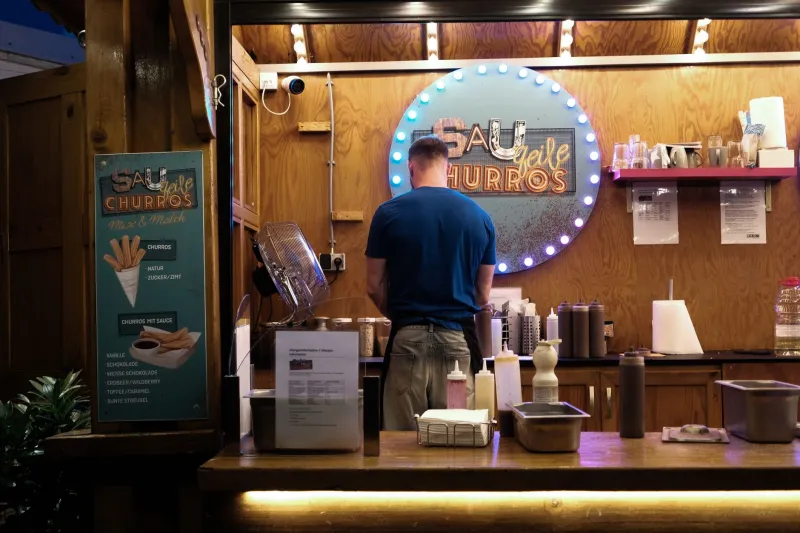
There is a specific panic that arrives around six o'clock on a Friday evening, when a trader realises the board they collected says one thing and the thing they need to say is quite another, and there is exactly one night to sort it. Anyone who has done a Saturday market, a food festival or a three-week run in a vacant unit knows the feeling. Temporary signage is unforgiving in a way that permanent signage almost never is. You cannot defer the decision to the next budget round, you cannot blame the managing agent, and you cannot disguise a weak message behind a well-lit interior and a nice doormat.
That compression is genuinely useful. It reduces signage to the job it is actually doing. Below is what traders tend to work out somewhere between the first gust of wind and the last fold of the gazebo, and how each lesson lands on a permanent shopfront, fascia or wayfinding scheme.
Ninety seconds, not three
The familiar shopfront rule says you have around three seconds of a passer-by's attention. At a stall you have less than that, because the person is moving through a crowd, mid-conversation, weighing you against the toastie van two pitches down. Traders who do well learn to front-load meaning: name first, category second, reason to stop third. Everything else is decoration.
Permanent signage drifts in the opposite direction because there is more room. The fascia acquires a strapline, three service icons, an award rosette, opening hours, a website, a QR code and a graphic swoosh, and the whole thing becomes a texture rather than a sentence. Stand twenty metres back from your own frontage and ask what a stranger would be able to repeat back to a friend. If the answer is nothing, the sign is doing less work than a hand-lettered board on a folding table.
What actually survives a gazebo
Craft lessons arrive fast when the weather turns. A few that traders learn the hard way:
- Correx is fine for a weekend and looks tired by the third weekend. It is a stopgap, not a material.
- Foamex at 5mm handles a season; 10mm handles being leaned on, dropped and re-used, which is what actually happens.
- PVC banner needs a decent weight and welded eyelets rather than punched brass ones. The first proper gust finds every weakness in the fixing, and a banner that flaps reads as an amateur operation long before anyone gets close enough to read the words.
- Printed vinyl on a pop-up window wants a removable, low-tack grade if the unit is short-let, and a cast vinyl if it is going to sit through a summer of sun on a south-facing pane. Calendered vinyl will shrink back and leave a hairline of adhesive that takes an afternoon to remove.
- Chalkboards and liquid chalk remain the fastest way to change a price, and the fastest way to look scruffy if nobody owns the job of rewriting them.
The permanent translation is unglamorous but valuable: specification discipline. When a quote comes in noticeably cheaper than the others, something invisible has usually been removed. Ask what grade of vinyl, what thickness of substrate, what fixing, what guarantee, and whether the edges are sealed. Traders who have watched a banner shred itself know to ask. Many organisations buying a fascia for the first time do not.
One message, or none
Ask a stallholder what they sell and you get a clean answer. Ask a small organisation what it does and you often get a paragraph covering four services, two audiences and an accreditation.
A stall cannot carry a paragraph. It can carry a name, a category and a hook. That constraint forces a useful hierarchy, and it is the same hierarchy a fascia needs. Decide the single thing the sign must communicate from the road, and let the rest live in the window, on the door, on the website or in the conversation inside. A sign that says one thing clearly outperforms a sign that says seven things politely.
Height is where temporary and permanent part company
On a stall, the sign has to clear shoulders. It sits above head height so it can be read through a crowd, which is why so many pitches end up with a banner strung from the gazebo frame. On a shopfront, the fascia sits three or four metres up and is read on a twenty-metre approach, which is a completely different calculation of letter height, contrast and spacing.
What does transfer is the habit of testing the sightline before committing. Take the final artwork, print it small, tape it to a wall at roughly the height and distance it will really be seen from, and look at it on a grim afternoon in February rather than on a bright screen in a warm office. Overcast British light flattens contrast; that deep charcoal on a mid-grey background looks decisive on a monitor and turns to mush on a wet Tuesday. Dark on light, generous spacing and a clean silhouette tend to hold up in every month of the year.
Worth noting too: if your stall instinct is to hang something out over the pavement, the same instinct on a permanent site means a projecting sign, which brings its own consent questions. The impulse is right; the paperwork is not optional.
What to carry back to the shopfront
Three practical things a short-life project teaches better than any brand workshop:
- Test cheaply, then spend. A printed A3 mock-up taped up for a week costs almost nothing and settles arguments that would otherwise run for a month.
- Watch real people, not feedback. Stand at your pitch, or outside your shop, and count how many people look up. Not how many compliment the sign. How many look.
- Design for the second glance. Temporary signage wins the first glance through novelty. Permanent signage has to survive familiarity, which means it should be plainer, calmer and more legible than the version you find exciting on a Friday night.
The stall is a rehearsal. It is unforgiving, it is short, and it tells you the truth about your message before you spend real money on a fascia you will be looking at for the next ten years.